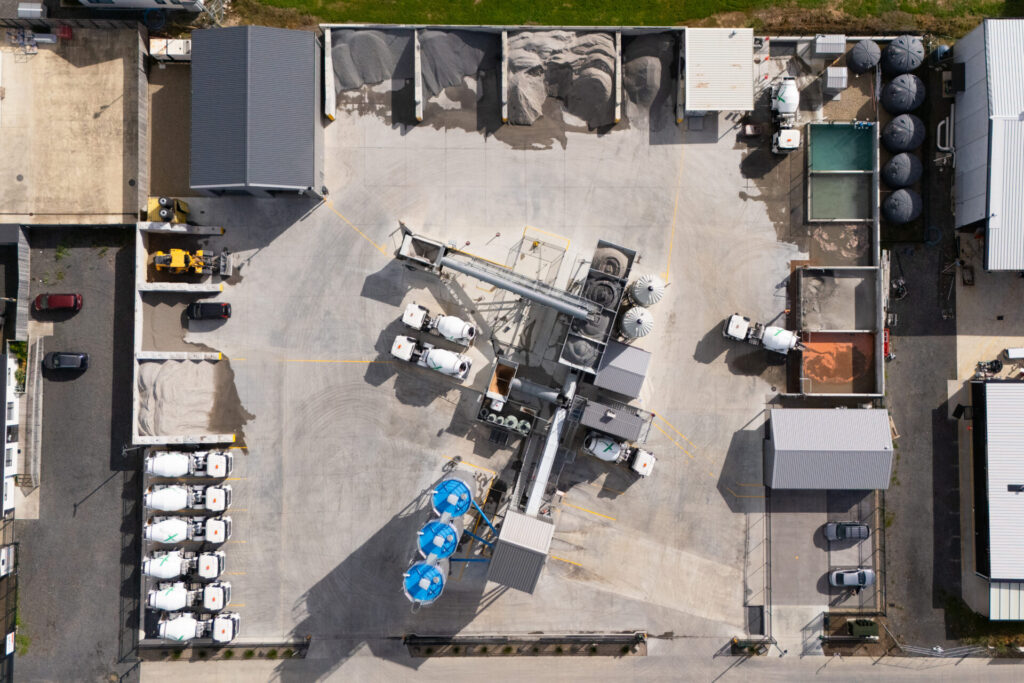
Concrete, according to UNI EN 206-1, is defined as «Material formed by mixing cement, coarse and fine aggregate and water, with or without the addition of admixtures, additions or fibers, which develops its properties through hydration».
Let us therefore see how concrete is quite different from cement, even though the two terms are often used interchangeably: cement is only one part of the whole set that then forms the final product, which is concrete, and which is the actual structural component of buildings, houses, roads, bridges, etc.
Concrete is in fact the result of a mixing process of different “ingredients”, much like a cake. And just like in pastry-making, also in the construction world, ingredients must be properly prepared, checked, dosed in the right quantities and at the right times, and mixed for a precise period of time.
As in cooking, in our field there are also different types of ingredients, of more or less high quality, which then affects the final result. And, likewise, the equipment and machines we use to mix our ingredients also affect the final result: think of when we use an old manual whisk instead of a powerful double-whisk electric mixer that reaches 5 speed levels.

Concrete News
Concrete quality: why the mixer and the plant make the difference
Mix design: which elements make up concrete
The components of concrete are the following.
• WATER: must always be subjected to suitability tests. It can also be water resulting from the processing cycle.
• AGGREGATES: natural or recycled, they are the skeleton of the concrete and consist of stone elements obtained by transforming rock masses through natural or artificial processes
• CEMENT: in turn composed of multiple elements, in particular clinker, which is also one of the most energy-intensive elements to produce.
• ADMIXTURES: liquid or powder, they are used to improve workability or strength of the concrete
• EXTRA: fly ash, silica fume
• FIBERS: steel or synthetic
How does the quality of the mixer influence the concrete production process?
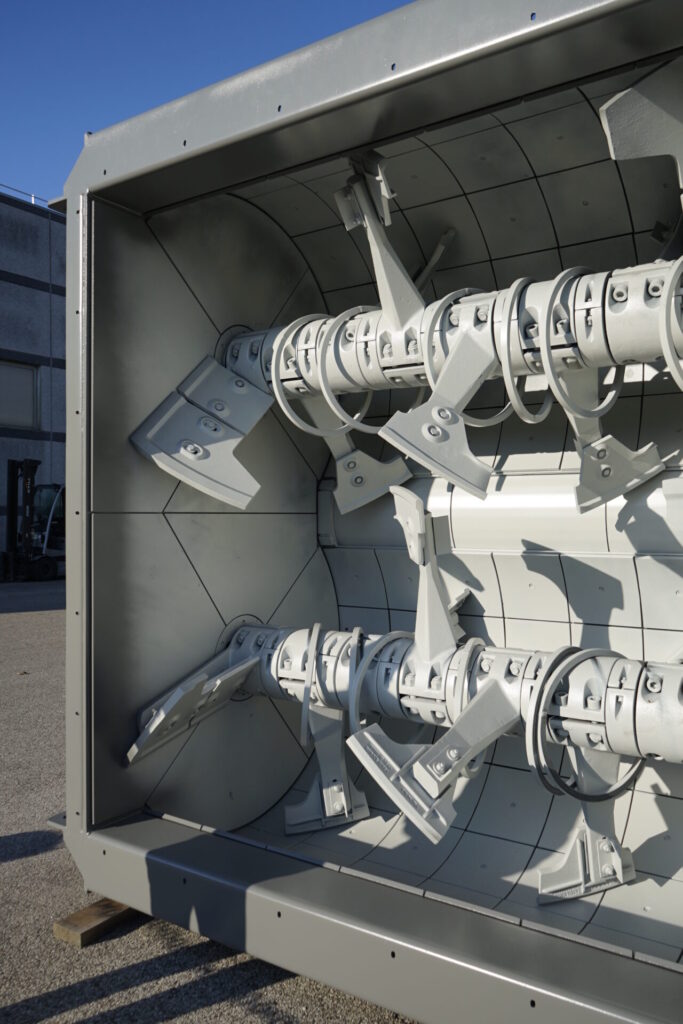
The mixer, at SIMEM we always say it, is the heart of the batching plant: the quality of the mixing directly affects homogeneity, strength and durability of the concrete. For this reason, it is essential to consider several characteristics when deciding to purchase a mixer, whether planetary or twin-shaft.
Strength: components must have a certain level of resistance to withstand work cycles and continuous wear due to contact with wet material. For this reason, SIMEM mixers are always internally lined with highly resistant wear plates, above all easy to replace during maintenance.
Mixing technique: thanks to collaboration with research centers and universities, Simem has thoroughly studied fluid dynamics to create Dyna-flow paddles, specifically designed for better mixing
Maintenance: internal wear plates are easily removable and replaceable, as are the paddles which are individually bolted to the shafts. Access and inspection doors are then essential for a clear and immediate view of the inside of the mixer.
In particular, in the twin-shaft Rhyno model, a tilting system gives access to the motor compartment, the most delicate and important one.
Not having reliable mechanics almost certainly means encountering potential issues such as: air in the mixture, non-homogeneous material and therefore lump formation, or even incomplete discharge of the material.
Consequently, this leads to poor quality of the final material which will be discarded and, above all, will result in economic damage for the contractor.
Which other plant elements significantly contribute to concrete quality?
In addition to the mixer, there are other elements that contribute to the proper functioning of a batching plant. Just as a heart needs other organs to function, so the mixer relies on other elements.
Aggregate receiving hoppers: regardless of capacity, it is important to avoid contamination of materials
Sensor systems: temperature and moisture level control are essential to keep drying times under control and avoid cracks from thermal shock
Dosing: precise scales ensure accurate dosing. Simem plants manage to be extremely precise, with an error percentage below 1%; this thanks to decades of studies, tests and
Layout: not only aesthetics but also order and precision. The arrangement of a plant in space is one of the key points and must take into account operations, maintenance access, production capacity.
Automation: if the mixer is the heart then the automation system is the “brain” of the plant. It is essential for the operator to have the possibility to work flexibly while maintaining control of the recipe, dosing times and mixing.
Conclusions: it is a matter of sinergy
In a batching plant, every component contributes to concrete quality, but it is the synergy between the mixer, control and plant design that makes the difference.
Relying on technologically advanced solutions means ensuring consistent performance, reducing waste and increasing competitiveness.
Discover how to improve your concrete quality today
Choose a partner that combines advanced technology, precision engineering and proven expertise.
Contact us to find the right solution for your batching plant and take your production performance to the next level.